

Moving Beyond “Support” Toward Strength-Based Play
Neurodiverse play is often discussed in terms of accommodation or support. But what if we shifted the lens? What if neurodiverse play wasn’t about fixing challenges — but about unlocking strengths?
Children who are autistic, have ADHD, or process the world differently often bring powerful abilities to learning spaces: intense focus, creativity, visual thinking, pattern recognition, originality, and persistence. The Six Bricks Method is uniquely positioned to honour these strengths. Through hands-on, play-based activities, children are free to engage in ways that match how their brains work — without being singled out or labelled.
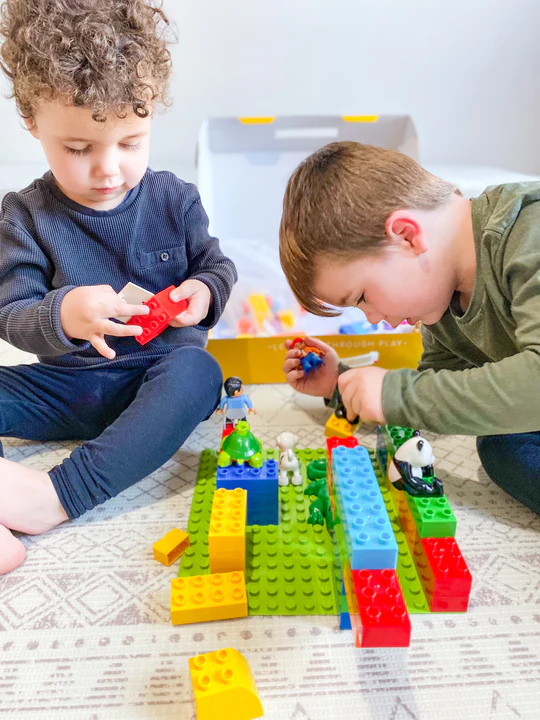
What Do We Mean by Neurodiverse Play?
Neurodiverse play recognises that children learn, regulate, and communicate in different ways — and that these differences are natural variations of human development.
Instead of expecting all children to sit still, listen for long periods, or respond verbally in the same way, neurodiverse play creates environments where children can:
- Move, build, and manipulate
- Communicate through actions, patterns, or visuals
- Repeat activities for mastery
- Choose how they participate
This approach benefits all learners — not only neurodivergent children.
Why Strength-Based Play Matters in Early Years
Early childhood is where children begin to form beliefs about learning and themselves. When play experiences are overly restrictive, some children quickly internalise messages such as “I’m not good at learning” or “school isn’t for me.”
Strength-based play helps children experience success before struggle, agency before compliance, and confidence before correction. Six Bricks activities are intentionally short, open-ended, and repeatable — making success visible and achievable from the very first interaction.
How Six Bricks Supports Neurodiverse Strengths
Six Bricks uses six DUPLO®-sized bricks in six colours, but the power lies in how they are used.
Visual Thinkers
Many neurodivergent children are strong visual learners. Six Bricks activities rely on colour cues, patterns, and spatial relationships. This allows children to process information visually rather than verbally.
Kinaesthetic Learners
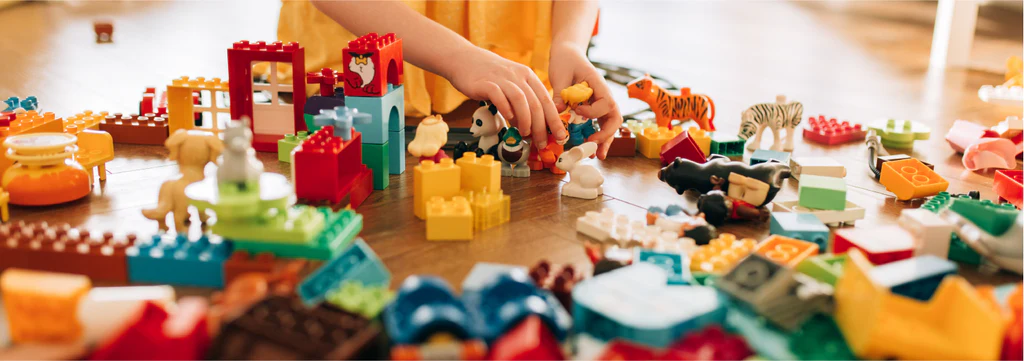
Some children learn best through movement and touch. Six Bricks provides constant opportunities to build, sort, stack, and rearrange. Learning happens through the hands — not just through listening.
Pattern and Systems Thinkers
Patterning, sequencing, and logical structures are embedded in Six Bricks activities. Children who naturally think in systems often excel when given predictable rules, repeatable challenges, and opportunities to extend patterns.
Independent and Deep Focus Learners
Neurodiverse play respects different engagement styles. With Six Bricks, children can work independently, repeat the same activity multiple times, and focus deeply without interruption. This kind of sustained engagement is often where learning flourishes.
Examples of Strength-Based Neurodiverse Play with Six Bricks
- Pattern Mastery: Invite children to create repeating or growing patterns. Some may build simple sequences; others may create complex designs. Both demonstrate meaningful learning.
- “Same Task, Different Outcome” Builds: Give one prompt: “Build something that stands.” Children choose how — tower, bridge, wall, or abstract structure. There is no single “correct” response.
- Non-Verbal Participation: Children can show understanding by copying a model, pointing to colours, or building a response. Speech is optional — learning is still visible.
- Regulation Through Repetition: Repeating familiar Six Bricks routines provides comfort and predictability, helping children regulate their energy and emotions without external pressure.
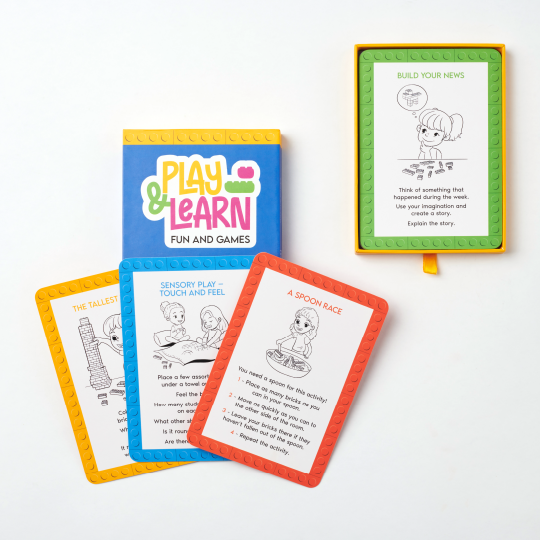
Neurodiverse Play at Home and School
In Classrooms
Six Bricks supports inclusive practice by allowing multiple entry points into activities, flexible grouping (solo, pairs, small groups), and smooth transitions using short play routines. This reduces behavioural stress and increases engagement.
At Home
Families can use Six Bricks to replace screen time with meaningful play, support regulation after school, and strengthen connection through shared activities. No specialist equipment is required — just consistency and curiosity.
Common Myths About Neurodiverse Play
“It’s only for autistic children.”
Neurodiverse play benefits every child by offering flexible pathways to learning.
“It’s unstructured.”
Six Bricks activities are highly intentional, with clear goals — just delivered playfully.
“Children won’t learn academics.”
Patterning, sequencing, memory, and language foundations are all embedded within play.
Key Takeaways
- Neurodiverse play is about recognising strengths, not deficits
- Children learn best when they can engage in ways that suit them
- Six Bricks offers visual, kinaesthetic, and low-language entry points
- Strength-based play builds confidence, motivation, and identity
- Inclusive play environments benefit all learners
FAQ
Is this approach suitable for all children?
Yes. Strength-based neurodiverse play supports neurotypical and neurodivergent learners alike.
Do children still need adult guidance?
Yes — educators and parents provide structure, modelling, and encouragement without controlling outcomes.
Can Six Bricks be used with older children?
Absolutely. Activities can be adapted for primary school learners by increasing complexity.
About the Author
Six Bricks Learning supports families and educators to create playful, inclusive environments where every child can learn in ways that honour their strengths.
Reframe Learning Today
Ready to reframe learning through a strengths-based lens? Explore Six Bricks resources and training and discover how neurodiverse play can unlock confidence and capability in every child.
Explore Resources & Training