
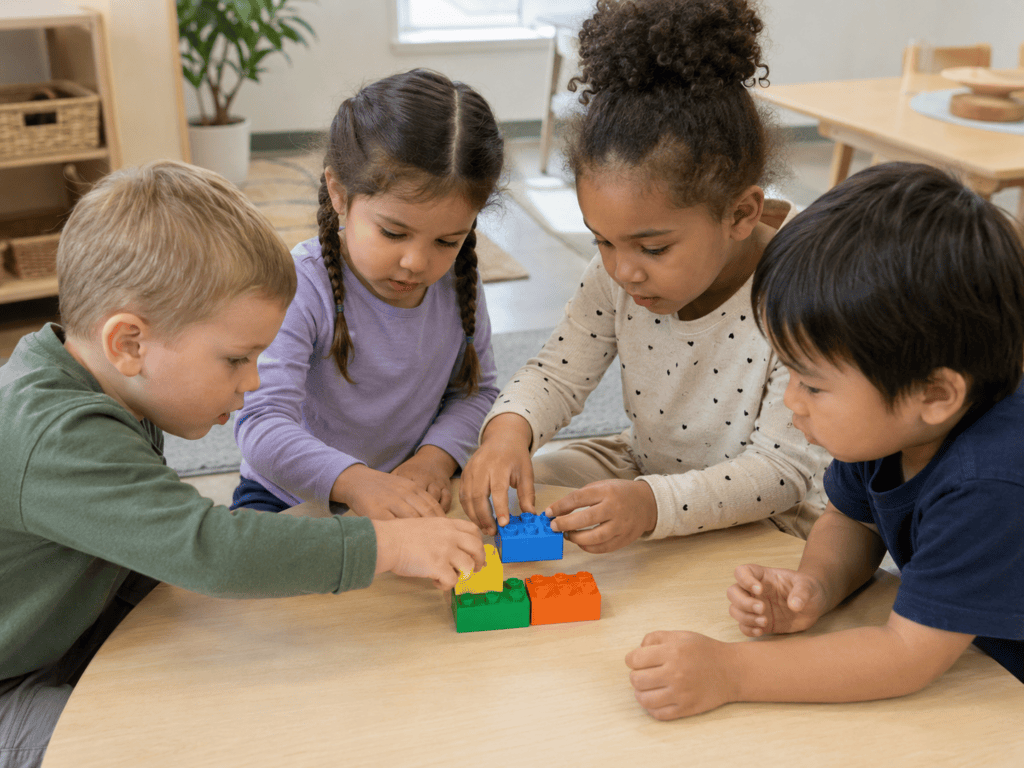
STEM Begins in Early Childhood — and It Begins in the Hands
Ask most education systems when STEM starts, and the honest answer is: later. High school. A laboratory, a robotics kit, a whiteboard full of equations. We talk about “the STEM pipeline” as though it begins around Grade 8. Then we act surprised when it turns out to be leaking.
Brent Hutcheson is the founder of Care for Education and the originator of the Six Bricks concept. He’s spent years arguing the opposite, and this post draws on that argument. STEM doesn’t begin in a laboratory, he says. It begins on a classroom floor, in the hands of a four-year-old. That child is stacking, sorting, balancing, knocking a tower over, and building it again. Everything we later call engineering thinking, scientific method, or mathematical reasoning is being rehearsed there. It happens in a form so ordinary that most adults walk straight past it.
This matters well beyond any one country. TIMSS 2023 found that roughly three-quarters of South African Grade 5 learners were functioning at or below the lowest international benchmark in mathematics. Science scores were no better. Similar warning signs about early mathematical foundations show up in system after system. By Grade 5, we’re measuring the accumulated consequence of what did, or didn’t, happen in a child’s first six years. Drawing on Brent’s thinking and the research behind it, here’s the case for manipulatives, material variety, and tinkering. Together they matter more than any curriculum we could write — and our assessment habits are quietly working against all three.
Quick Overview
- Who is this for? Early childhood and primary educators, centre leaders, and curriculum decision-makers.
- What will you learn? You’ll learn why hands-on manipulation starts STEM thinking, and why material variety works like its own curriculum. You’ll also see why tinkering deserves to be core practice, and why assessment habits often work against it.
- Key takeaway: Put more materials in children’s hands, value process over product, and rethink what gets measured early on.
Children Think Through Their Hands
Watch a young child discover that a tall tower needs a wide base. You’re watching a hypothesis get tested in real time. Nobody taught them about centre of gravity — they found it by building something that toppled, then building it differently.
It isn’t just charming to watch; it’s neurologically significant. In the brain’s sensory and motor maps, the hand takes up far more cortex than its size would suggest. Children really are wired to think through their fingers before they think in words. Handling an object isn’t a warm-up before “the real learning” starts — for a young child, it is the learning. As Brent Hutcheson puts it, “the hand is the first laboratory.”
What the Research Actually Shows
The research backs this up, with an important caveat worth being honest about. A meta-analysis by Carbonneau, Marley and Selig covered 55 studies and more than 7,000 learners. It found that teaching mathematics with concrete manipulatives produced small-to-moderate gains over abstract instruction alone. But the size of the effect depended heavily on how the manipulatives were used. Simply handing a child blocks isn’t a method in itself. What matters is the quality of thinking an adult invites around them.
Longer-range evidence points the same direction. Wolfgang, Stannard and Jones followed children from preschool into high school. They found that the complexity of their block play at age four was associated with mathematics achievement years later. That’s correlational, not causal. But it lines up with a much larger body of research: spatial reasoning is a strong predictor of STEM achievement, and it’s trainable. Pooling 217 training studies, Uttal and colleagues found an average improvement of roughly half a standard deviation. The gains were durable, and they transferred to tasks children had never practised.
Half a standard deviation, and it holds. If a pill produced that result, it would be in the water supply. Instead, it comes from blocks, bricks, bottle tops, clay, sticks, string, and sand. Many classrooms still treat these as what happens once the “real work” is done.
Why Material Variety Works Like a Curriculum of Its Own
It isn’t enough to hand a child one type of manipulative. Variety itself does teaching that a single material can’t:
- Wet sand teaches cohesion and slump; dry sand teaches the opposite.
- Clay holds a shape and punishes a rushed hand.
- Paper folds but will not stretch.
- Water finds its own level, no matter how carefully it’s poured.
- A wooden block is rigid and predictable; fabric is not.
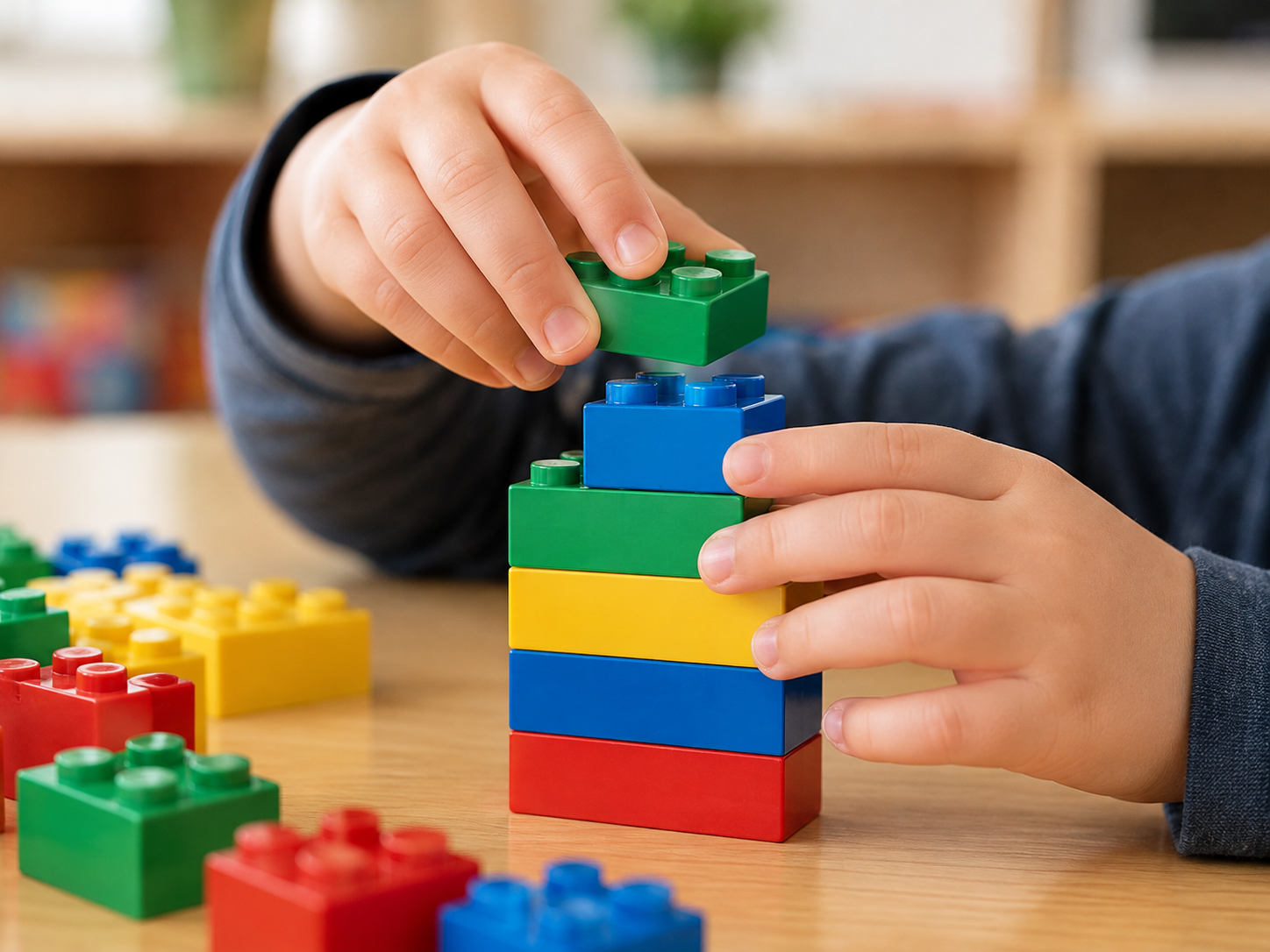
- Interlocking bricks teach modularity, unit, symmetry — and the fact that some things join together and others simply don’t.
A child who has only ever built with one material has learned exactly one material’s behaviour. A child who has worked through a dozen has begun building something more valuable: an intuitive, embodied sense of how the physical world behaves. That’s precisely the foundation a Grade 10 physics lesson quietly assumes every learner already has. And it’s precisely what many learners arrive without, simply because nobody put enough different things in their hands early on.
This is also the strongest case for low-cost materials. Variety doesn’t require a budget. It just takes a cardboard box, bottle tops, fabric offcuts, a handful of pegs, six bricks. The real barrier is rarely money. It’s that loose, open-ended, “messy” materials are too often treated as filler rather than as serious pedagogical equipment. They should sit alongside a structured resource, not replace one.
Tinkering Deserves to Be Core Practice, Not a Friday Treat
Tinkering happens when a child is handed interesting materials, a loose invitation, and enough time. From there, the child makes their own decisions about what to try. It’s iterative, improvisational, and full of false starts. It goes sideways. It produces things nobody planned, including the child. The Exploratorium’s Tinkering Studio has spent years building a framework for observing exactly this. It tracks the initiative a learner takes, the persistence they show, and the way an idea gets developed and pursued. The learning shows up in the doing, not in whatever’s left on the table afterward.
This maps closely onto what the LEGO Foundation calls the five characteristics of learning through play. They are: joyful, meaningful, actively engaging, iterative, and socially interactive. Iterative is usually the one classrooms skip. Most are genuinely good at joyful. Far fewer make room for a child to try the same thing eleven times. Eleven attempts look inefficient on a lesson plan.
Functionally, this is what engineers and scientists actually do all day. They define a problem loosely, try something, watch it fail, adjust, try again, notice something unplanned, and follow it. Design thinking, creative problem-solving, and the scientific method are, in a real sense, formal versions of one thing. It’s what a three-year-old with an interesting pile of objects does naturally — until it gets trained out of them.
Practical Example: What This Looks Like on a Six Bricks Desk
Picture a Reception classroom where a small tub of six plain, DUPLO®-style bricks sits permanently within reach on every table. It isn’t brought out for a lesson and put away — it’s simply always there, inviting a child to build.
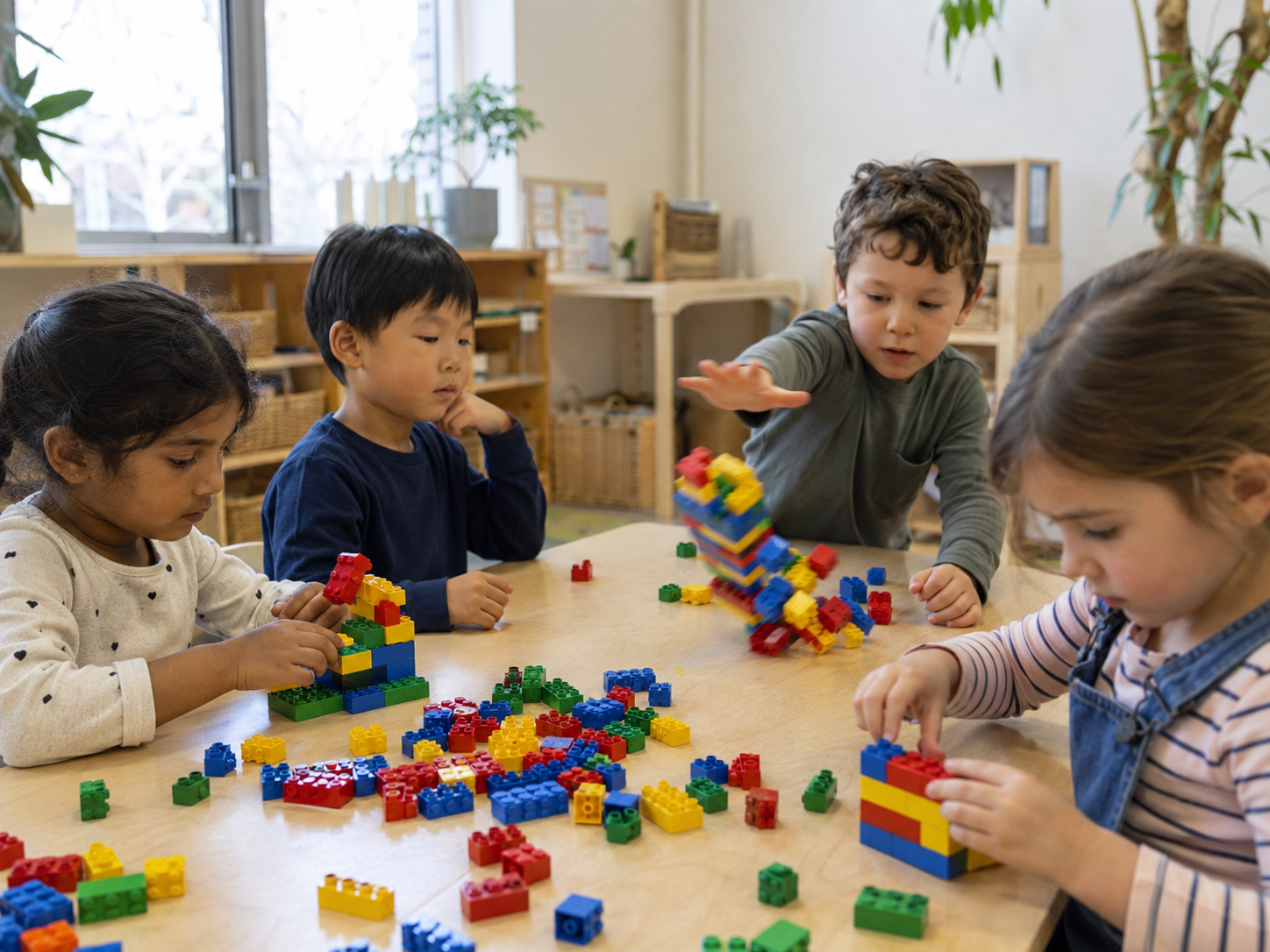
One child spends ten minutes planning a structure before placing a single brick. Another builds, knocks it down, and rebuilds it three different ways in the same stretch of time. A third narrates every move; a fourth works in total silence and only speaks once the tower stands. None of these children is doing it “better” or “worse.” They’re running genuinely different problem-solving processes. And each one tells an attentive educator something real about how that child thinks.
This is the practical core of it: put materials within reach, leave them there, and add whatever else is on hand. Then comes the hardest part — stepping back and letting the child lead. Six Bricks activities are deliberately plain for exactly this reason. Nothing about the brick’s shape tells a child what to build, so the tinkering stays genuinely open.
Judge the Process, Not Just the Finished Tower
Take this seriously, and it changes what educators need to be watching. Every child has their own route through a problem. One plans the whole structure before touching a brick. Another builds and rebuilds. One narrates every move. Another needs to knock the tower down before building a better one. These aren’t stages on a ladder from worse to better. They’re different processes, and each one reveals something real about how that child thinks. This is inclusive education in practice.
Understanding how each child learns is one of the most important things an early years practitioner does. That means teaching into a child’s process, rather than around it. It’s also one of the hardest things to talk about, because the field has rarely built the vocabulary for it.
Judge only the end result, and that information disappears. Two children hand in an identical tower. One arrived by careful planning. The other arrived after twenty minutes of stubborn trial and error, three collapses, and a solution nobody in the room had thought of. The finished product says they’re the same. It isn’t. And the child who did the more genuinely scientific work is often the one marked down for being slow.
Several traditions get this right: Reggio Emilia’s pedagogical documentation, learning stories, and the Tinkering Studio’s own learning dimensions. They share a common thread. Each treats the record of the process itself as the assessment, not as a nice-to-have supplement to it. Educational researcher Carla Rinaldi has argued for decades that documentation is assessment, not preparation for it. Early childhood practice, on the whole, still hasn’t fully absorbed that idea.
Why Assessment, Not Curriculum, Might Be the Real Lever
Why Measuring Only Outcomes Backfires
Here’s the argument worth sitting with: changing how we assess early STEM learning could be what actually shifts outcomes. Not the curriculum. Not only the resourcing, important as that is.
Assessment tends to be the tail that wags the entire dog. Educators teach to what they’re held accountable for measuring. When only correct answers and finished products count, classrooms receive an unmistakable signal: the attempt doesn’t matter, only the outcome. Once a child absorbs that lesson, tinkering stops making sense. Why try something that might fail, if failure is the only thing being scored?
That’s one way to end up with children who can complete a worksheet but freeze in front of an open-ended problem. It’s also, quite possibly, how we end up with adults who quietly believe they’re “not a maths person.”
What Process-Based Assessment Looks Like
The alternative: build early-years assessment around evidence of process. How does a child define a problem? How many strategies do they try? What do they do when something doesn’t work? How do they adapt an idea, explain their reasoning, or build on someone else’s? All of this is observable. All of it can be recorded by a practitioner with a phone and five minutes. None of it requires a new textbook.
Once that’s what counts, the incentives change all the way upstream:
- Practitioners are freed to put out more materials, not fewer.
- A third attempt becomes valuable instead of wasteful.
- Persistence becomes a reportable strength.
- Children learn, from the very beginning, the thing that underpins a life in STEM. As Brent Hutcheson puts it, “not knowing yet is the normal, respectable, interesting condition of anyone doing real work.”
Key Takeaways
- STEM thinking doesn’t start in a high school lab — it starts in a young child’s hands, through stacking, sorting, balancing, and rebuilding.
- Manipulatives produce real gains in mathematical understanding. But that’s only when adults engage children in genuine thinking around them, not simply hand out objects.
- Spatial reasoning, built through block and brick play, is a strong and trainable predictor of later STEM achievement.
- Material variety functions as its own curriculum — every material (sand, clay, water, fabric, bricks) teaches something the others cannot.
- Tinkering — open-ended, iterative, adult-guided-but-child-led exploration — deserves to be a core mode of early learning, not an occasional reward.
- It’s the process that should be assessed, not just the product. That’s what makes tinkering and persistence worth a child’s effort in the first place.
FAQ
What are manipulatives in early childhood education, and why do they matter?
Does block play actually predict later maths achievement?
What is tinkering in early childhood learning?
Why should early childhood assessment focus on process instead of the finished product?
How can educators bring more material variety into a classroom without a big budget?
Put More Materials in More Hands
Ready to make open-ended tinkering a daily habit and start observing the process, not just the product? Explore our Group Kits to bring genuinely open-ended building onto every desk. Or enrol in our online courses to build your confidence observing and documenting how each child actually thinks.
Explore Group Kits