
How Spatial Awareness Builds Maths Readiness — and How Six Bricks Can Help
Why spatial awareness is the missing piece in early maths
Ask most people what maths readiness looks like in a young child and they will describe a child who can count to ten, recognise numerals, or recite a number sequence. Those are real skills — and they matter. However, developmental research consistently points to something less obvious, and arguably more foundational: the ability to think spatially. In other words, to understand where things are in relation to each other, to mentally rotate a shape, follow a sequence across a grid, or predict where a pattern will go next.
Research indicates that spatial ability at age 4 is one of the strongest predictors of mathematical ability at age 8. Yet in many classrooms, educators quietly drop spatial reasoning activities the moment counting and number work begin — just when children need them most. Consequently, this blog explores what spatial awareness actually is, why it matters so deeply for maths, and how structured, hands-on activities using six DUPLO®-style bricks can build this critical skill across the early years and into primary school.
Quick Overview
- Who is this for? Early childhood educators, Foundation–Year 3 teachers, occupational therapists, and parents of early learners.
- What will you learn? Why spatial awareness underpins maths readiness, how to recognise it in the classroom, and how Six Bricks activities develop it in short, structured bursts.
- Key takeaway: Spatial awareness activities for early maths readiness are not extras — they are the foundation that maths learning builds on.
What Is Spatial Awareness — and Why Does It Matter for Maths?
Spatial awareness is the ability to understand and reason about the position, shape, size, and movement of objects in relation to each other and to ourselves. Put simply, it is the cognitive skill that lets a child know which brick goes next in a sequence, recognise that a rotated shape is still the same shape, or navigate from one part of a room to another using a mental map.
Spatial reasoning sits at the heart of mathematical thinking
For young learners, spatial reasoning is not a side skill — it sits at the heart of mathematical thinking. When a child groups objects by size, lines up bricks in a colour pattern, or works out which piece fits in a gap, they are practising spatial reasoning. Crucially, those same mental processes transfer directly into number concepts, measurement, geometry, and even early algebraic thinking.
Developmental research broadly supports the view that spatial and mathematical reasoning share deep cognitive roots. Therefore, children who develop strong spatial skills in their early years consistently show better outcomes in numeracy, pattern recognition, and problem-solving as they move through primary school. As a result, spatial reasoning and perceptual skills form a foundational layer for mathematical thinking. Yet many schools discontinue manipulatives and hands-on spatial activities in primary years — despite the clear ongoing developmental need.
The three key spatial skills children develop through play
- Spatial visualisation — the ability to mentally represent and manipulate objects. A child building a pattern with bricks and then copying it from memory is practising this skill.
- Spatial orientation — understanding position and direction. Activities that ask children to place a brick “above,” “beside,” or “behind” another develop this directly.
- Spatial reasoning under sequence — following and predicting ordered patterns. Recreating a brick sequence from left to right mirrors the same left-to-right processing that underlies reading and number lines.
Why Spatial Learning Often Gets Left Behind
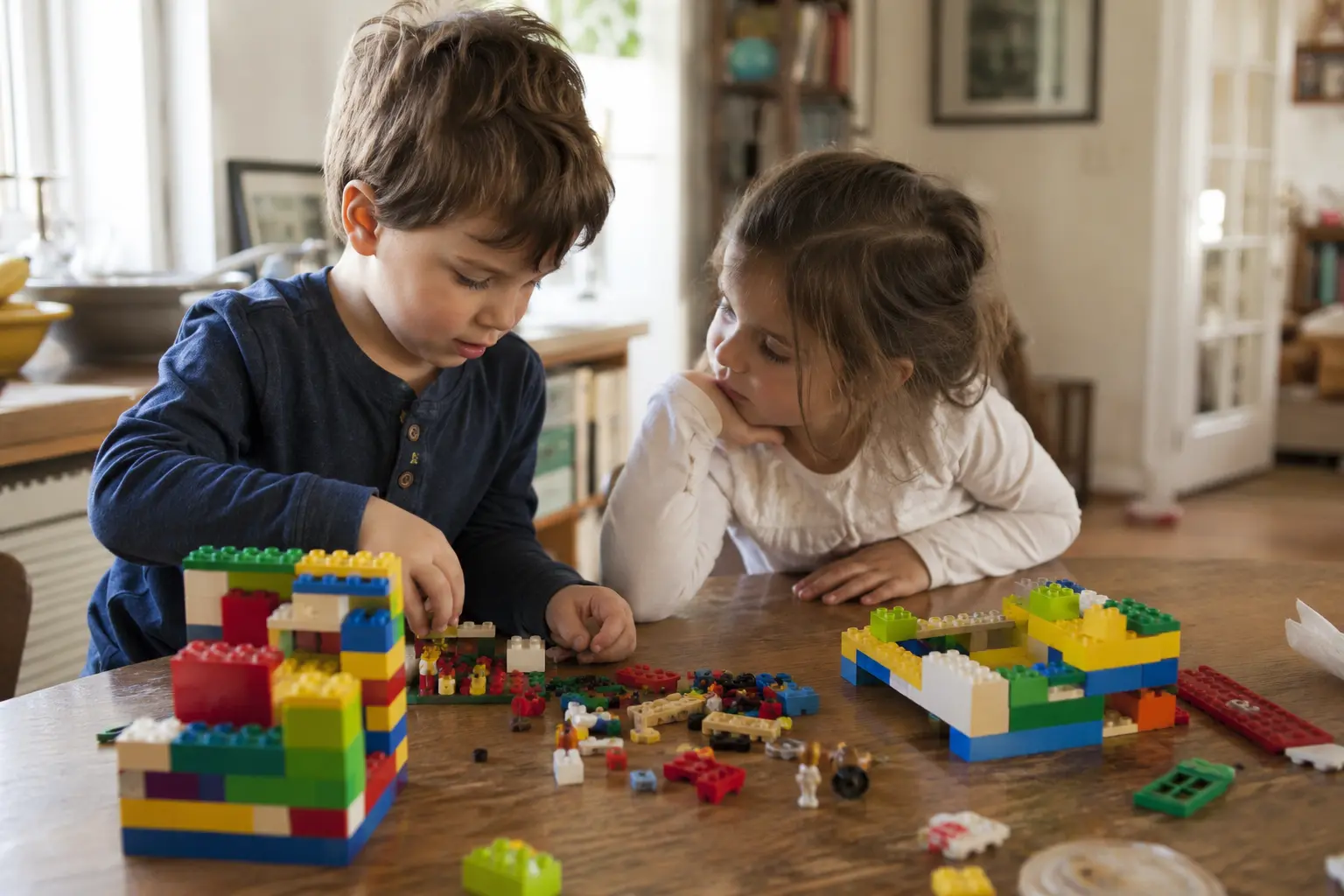
Many educators assume that spatial and perceptual learning belongs to early childhood — to the block corner in a nursery or the puzzle table in Pre-K. The assumption is that once children start “real” maths with numbers and symbols, the hands-on spatial work is no longer needed. However, the evidence does not support this view.
The embodied cognition framework in educational research supports the continued use of physical manipulatives well into primary school. When children handle and move objects, they build stronger conceptual understanding. Learning lives in the body as much as in the mind. A child who has physically arranged bricks in patterns, sequences, and spatial relationships has a cognitive scaffold to hang abstract number concepts on. A child without that experience must build those concepts in mid-air.
What this looks like in classrooms
Many educators notice it without naming it. Consider the Year 1 child who struggles with number lines — not because they cannot count, but because sequential left-to-right representation is still developing. Or the child in Year 2 who cannot hold a mental image of a shape long enough to rotate it on a page. Similarly, a child who reverses numerals persistently is often not being careless — their spatial representation system is still finding its footing.
The good news: spatial skills are trainable
These children do not need more rote number practice. Instead, they need more structured spatial play. The evidence is clear that spatial skills are highly trainable. Short, repeated activities — even two to five minutes a day — are enough to build the neural patterns that support spatial reasoning over time.
How Six Bricks Develops Spatial Awareness for Maths Readiness
Brent Hutcheson developed the Six Bricks methodology through Care for Education in South Africa. Six Bricks Learning now delivers it globally. Specifically, the methodology uses six DUPLO®-style bricks in six colours — yellow, green, light blue, dark blue, red, and orange — to engage children in structured, multi-sensory activities. Together, those activities develop all five developmental domains: cognitive, social, emotional, physical, and language. Notably, many of them have a direct spatial component.
Six Bricks activities are multi-sensory by design. Children touch, see, and actively engage with the bricks rather than observing passively. As a result, the activities strengthen memory encoding and support children who learn best through hands-on experience. That is why Six Bricks is particularly effective for building spatial awareness in a way that sticks.
The B-line mat: a dedicated spatial learning tool
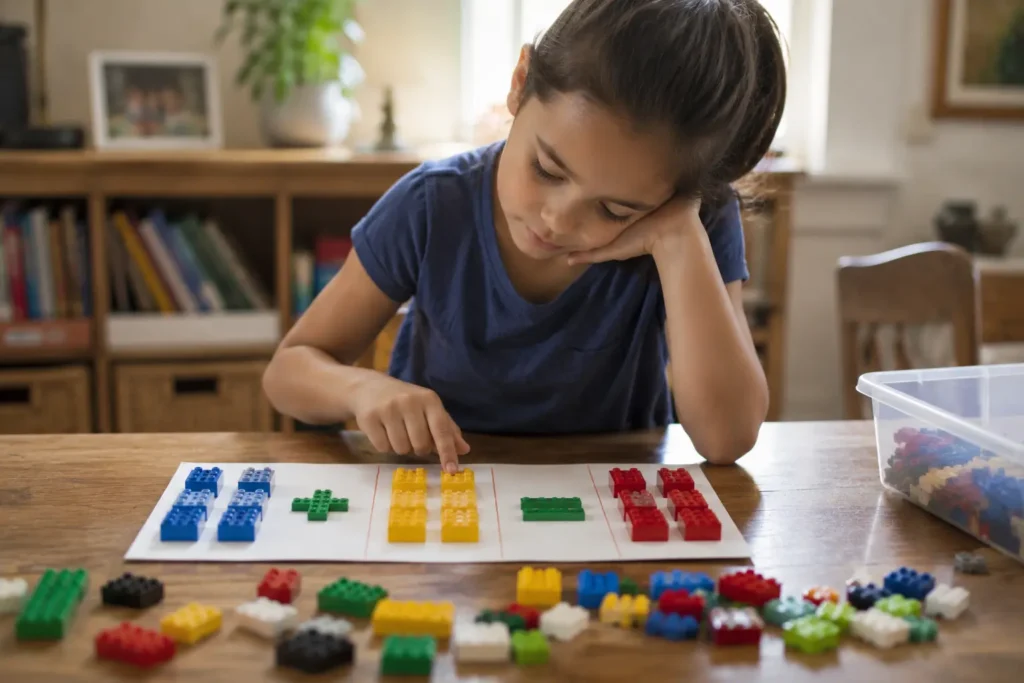
The B-line mat is part of the Six Bricks educational resources range. It is specifically designed to develop spatial awareness and sequential reasoning. Children place bricks along the mat’s structured grid, following patterns, sequences, and directional cues. These cues directly mirror the cognitive demands of early maths. Working left to right across a sequence, identifying what comes next, holding a pattern in working memory long enough to replicate it — these are exactly the skills that transfer into number line comprehension, measurement, and pattern-based maths tasks.
Working memory and spatial reasoning — a powerful connection
Spatial awareness activities also develop working memory — the brain’s ability to hold and use information in real time. Working memory supports every act of intentional learning. It is what allows a child to follow a multi-step instruction or work through a word problem without losing track. Moreover, children with stronger working memory tend to show better reading and numeracy outcomes in primary school. Many Six Bricks activities ask children to hold a sequence in mind, act on it, and check their result — giving working memory a genuine, enjoyable workout in the process.
Spatial Learning in Practice: A Classroom Scenario
Imagine a Foundation class of twenty-two children. Each morning, the educator opens the day with a five-minute Six Bricks brain break. Today’s activity uses the B-line mat. Children pick up their six bricks and sit at their tables. The educator places a sequence on her mat — red, blue, green — and holds it up. “Watch carefully,” she says. “Now turn your mat over, and place the same pattern from memory.”
What is actually happening cognitively
What looks like a simple game is doing something cognitively significant. First, each child encodes a visual-spatial sequence. Then they hold it in working memory, translate it into physical action, and check the result against the original. Those who find it easy receive longer sequences as a challenge. Those who find it harder keep the original visible — so the activity sits within their Zone of Proximal Development. As Vygotsky described it, the task is challenging enough to build new skills, yet supported enough to feel achievable.
After three weeks of daily practice, the educator notices a shift. More children approach number line activities with confidence. Numeral reversals become less frequent. Consequently, pattern-based maths tasks need less prompting to complete. Nothing in the maths curriculum has changed — only the five minutes at the start of each day.
Practical Spatial Awareness Activities for Early Maths Readiness
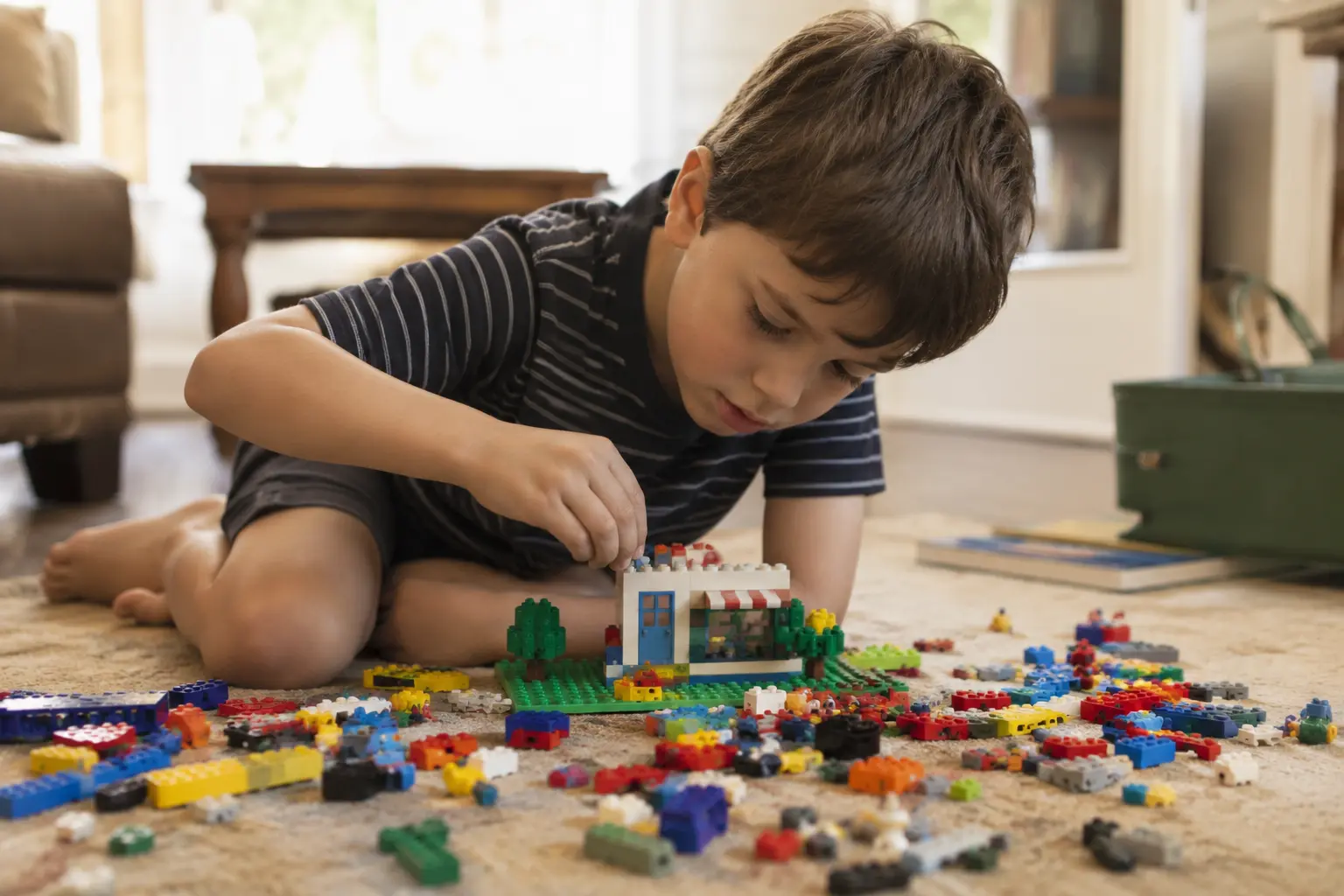
You do not need a specialist programme to begin building spatial awareness in your classroom or at home. In fact, six DUPLO®-style bricks are all you need. Here are five short, structured activities that develop this critical skill — each taking between two and five minutes.
Five activities to try today
- Sequence and replicate — create a three-brick colour sequence and ask children to copy it exactly, then extend it. This develops pattern recognition and visual-spatial memory.
- Follow directional cues — ask children to place a brick “in front of,” “behind,” “to the left of,” or “on top of” another. This builds positional language and spatial orientation at the same time.
- Mirror the pattern — place a sequence on one side of the mat and ask children to create its mirror image on the other side. This directly practises mental rotation — one of the strongest predictors of geometry skill.
- Hide and recall — show a brick arrangement for ten seconds, then cover it. Ask children to reconstruct it from memory. This is a direct working memory challenge with a spatial encoding component.
- Describe and build — one child describes a brick arrangement in words; a partner builds it without seeing the original. This combines spatial reasoning, language development, and listening skills — three developmental domains in a single activity.
Taking it further with the Six Bricks for Maths course
Each activity above requires no additional preparation once children know the routine. Furthermore, educators can scale them across a wide age range with appropriate scaffolding. For those who want to go deeper, the Six Bricks for Maths online course walks through how to use the methodology specifically to build numeracy and foundational mathematical skills — including spatial awareness — with confidence.
Key Takeaways
- Spatial awareness is one of the strongest early predictors of mathematical ability — and it is highly trainable through structured play.
- Hands-on, multi-sensory activities with DUPLO®-style bricks develop the spatial reasoning skills that underpin number concepts, pattern recognition, and measurement.
- The Six Bricks B-line mat is specifically designed to build spatial awareness and sequential reasoning — skills that transfer directly into early maths success.
- Short, daily spatial routines — even two to five minutes — are enough to build meaningful cognitive gains over time.
- Spatial activities also develop working memory and executive function, giving children a broader cognitive readiness for formal learning.
- Spatial learning belongs in primary school, not just early childhood — the developmental need continues well beyond Foundation year.
Frequently Asked Questions
About spatial awareness and maths
What are the best spatial awareness activities for maths readiness in early childhood?
How does spatial awareness help with maths in primary school?
What is the Six Bricks B-line mat and how does it support spatial learning?
About Six Bricks in practice
Can I use Six Bricks activities for spatial learning with neurodiverse children?
How long does it take to see results from spatial awareness activities in the classroom?
Ready to build spatial awareness in your classroom?
Explore our Six Bricks for Maths online course and bring evidence-aligned, hands-on maths readiness activities into your daily practice — starting today.
Explore the Maths Course